
Antioxidants and Male Fertility: Which Supplements Actually Work
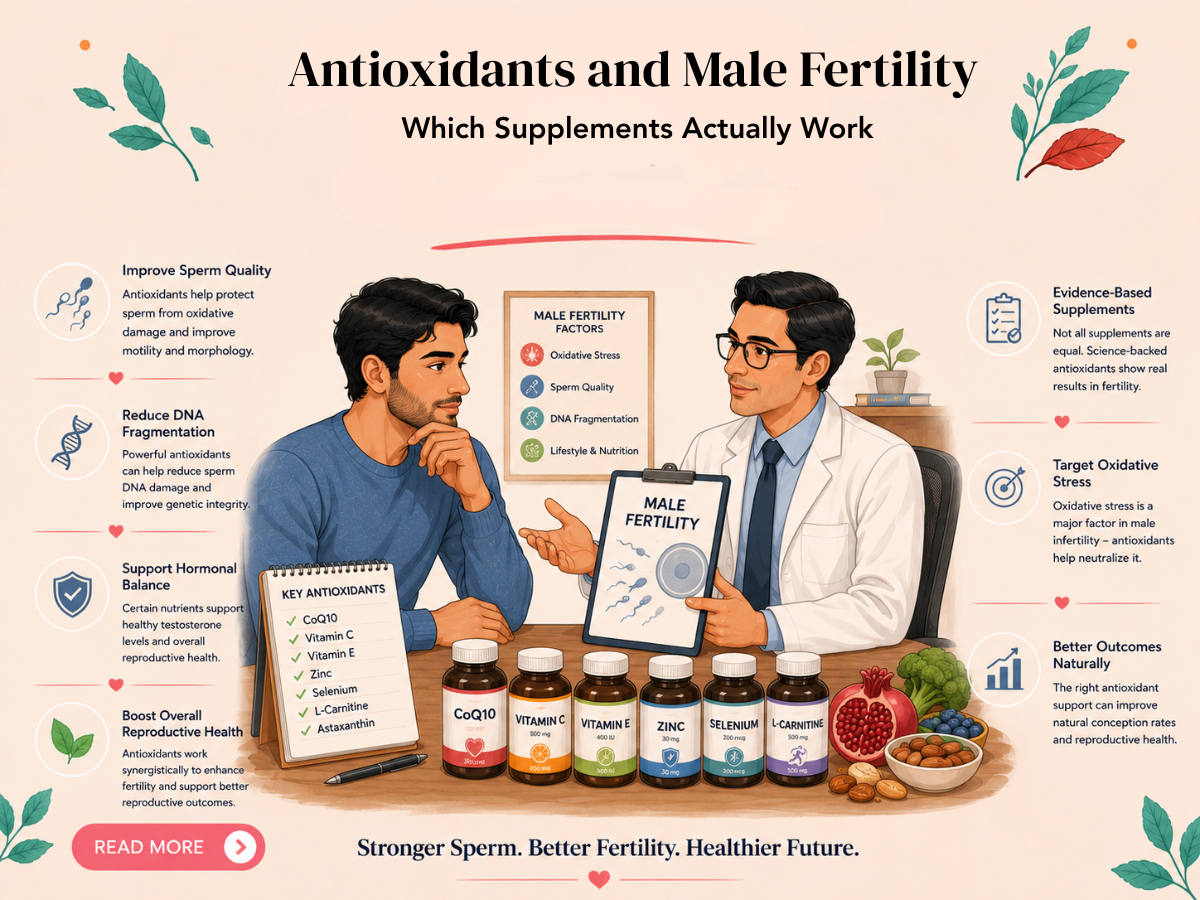
The market for male fertility supplements in India is large, loud, and often misleading. Products make sweeping claims about "boosting sperm count 300%" or "guaranteed improvement in 30 days." The reality is considerably more modest — but there is genuine, peer-reviewed evidence that specific antioxidant supplements improve specific aspects of sperm quality, particularly DNA fragmentation and oxidative stress markers.
This guide reviews the evidence for the most important ingredients in male fertility supplementation — what each one does, what the evidence shows, what the appropriate dose is, and what realistic expectations look like.
Why Antioxidants? The Oxidative Stress Framework
The mechanistic foundation for antioxidant supplementation in male fertility is well established. Oxidative stress — the imbalance between reactive oxygen species (free radicals) and antioxidant defences in the male reproductive tract — is the single most common mechanism of sperm DNA damage, impaired motility, and reduced fertilisation capacity.
Sources of excess ROS in the male reproductive tract include leukocytes (white blood cells), immature sperm cells, dysfunctional varicocele circulation, heat exposure, and systemic oxidative load from smoking, obesity, and environmental toxins. Antioxidant supplementation works by augmenting the body's natural defences against this oxidative load.
Importantly, antioxidant supplementation is most effective when oxidative stress is genuinely elevated — not as a universal enhancement for all men. Men with already-normal semen parameters and low DNA fragmentation are unlikely to see further improvement. Those with elevated DNA fragmentation, poor motility, or oligospermia driven by oxidative stress have the most to gain.
The Evidence: Ingredient by Ingredient
CoQ10 (Coenzyme Q10) — The Most Important
CoQ10 is both an antioxidant and a mitochondrial cofactor — it participates directly in the electron transport chain that generates ATP, the energy currency of cells. In sperm, CoQ10 is concentrated in the midpiece, where the mitochondria that power sperm swimming are located. CoQ10 levels in semen have been shown to correlate with progressive motility.
Evidence: Multiple randomised controlled trials have demonstrated that CoQ10 supplementation (200 to 600 mg/day) improves total and progressive sperm motility, sperm count, and — importantly — reduces DNA fragmentation. The ubiquinol form of CoQ10 (the active, reduced form) is more bioavailable than ubiquinone and is preferred.
Recommended dose: 200 to 600 mg ubiquinol daily for a minimum of 3 months.
Vitamin C (Ascorbic Acid)
Vitamin C is a powerful water-soluble antioxidant present in high concentrations in seminal plasma — its natural concentration here suggests a specific biological role in protecting sperm from oxidative damage. Studies show that vitamin C supplementation improves sperm count, motility, and morphology, and reduces DNA fragmentation in men with elevated oxidative stress. Vitamin C also regenerates vitamin E after it has neutralised a free radical, amplifying the effect of combined supplementation.
Recommended dose: 500 to 1000 mg daily.
Vitamin E (Alpha-Tocopherol)
Vitamin E is the primary fat-soluble antioxidant and protects sperm cell membranes — which contain high concentrations of polyunsaturated fatty acids that are vulnerable to lipid peroxidation. Studies combining vitamin C and vitamin E show additive or synergistic benefit on motility and DNA fragmentation. Vitamin E alone at 400 IU daily has shown improvements in morphology in several trials.
Recommended dose: 400 IU daily.
Zinc
Zinc is essential for testosterone synthesis, sperm production, and sperm maturation. It is the most concentrated mineral in semen. Zinc deficiency is associated with hypogonadism, oligospermia, and reduced testosterone. Supplementation in zinc-deficient men consistently improves testosterone levels and semen parameters. Even in men with borderline zinc status, supplementation supports spermatogenesis.
Recommended dose: 15 to 30 mg elemental zinc daily.
Selenium
Selenium is a cofactor for glutathione peroxidase — one of the body's primary antioxidant enzyme systems. It is essential for normal sperm development and motility. Selenium-deficient sperm show impaired motility and increased oxidative damage. Supplementation studies show improvements in motility and DNA integrity.
Recommended dose: 50 to 100 mcg daily. Important caveat: selenium has a narrow therapeutic window — doses above 400 mcg per day can cause toxicity. Do not supplement at high doses.
Folate (Folic Acid / Methyl Folate)
Folate is involved in DNA synthesis and repair — relevant to sperm DNA integrity. Men with low folate status have higher rates of sperm DNA fragmentation and chromosomal abnormalities. Combined folate and zinc supplementation has been shown to improve total sperm count in subfertile men in randomised trials.
Recommended dose: 400 to 800 mcg daily.
Lycopene
Lycopene is a carotenoid antioxidant found in high concentrations in tomatoes (particularly cooked tomatoes). Observational studies show that men with higher dietary lycopene intake have better sperm morphology. Small intervention studies show modest improvements in morphology with supplementation. The mechanism involves ROS reduction and lipid peroxidation protection in the sperm membrane.
Recommended dose: 4 to 8 mg daily (achievable through dietary intake of tomato products, or supplementation).
L-Carnitine
L-carnitine is essential for sperm energy metabolism, particularly in the epididymis where sperm acquire motility. Seminal carnitine levels correlate with progressive motility. Supplementation studies show improvements in motility — making it particularly relevant for men with asthenospermia. Often combined with CoQ10 for synergistic mitochondrial energy support.
Recommended dose: 2 to 3 g daily.
What to Avoid
Two categories worth flagging:
- Products with undisclosed ingredients: Supplements with "proprietary blends" that do not list individual ingredient doses should be avoided. You cannot assess whether the included amounts are at evidence-based levels.
- Extremely high selenium or vitamin A: As noted, excessive selenium causes toxicity. Vitamin A in megadoses can impair spermatogenesis. Avoid single-nutrient products at very high doses without medical guidance.
How Long Before Results?
Spermatogenesis takes approximately 72 to 74 days. Any supplement effect on semen parameters will take a minimum of three months to manifest. A repeat semen analysis and DNA fragmentation test at 3 and 6 months after starting supplementation provides objective evidence of benefit — or confirms that escalation (varicocele repair, testicular sperm retrieval) is needed.
Frequently Asked Questions
Q1. Should I take a combined male fertility supplement or individual ingredients?
Both approaches are valid. Quality combined male fertility supplements (such as those from reputable brands with transparent ingredient disclosure) are convenient and cover all the evidence-based ingredients in appropriate doses. Building a regimen from individual supplements allows more precise dose control but requires more attention and expense. The most important criterion is that each included ingredient is at an evidence-based dose — not just present as a token amount.
Q2. Are these supplements safe to take during IVF?
Yes — antioxidant supplements are generally safe and may be continued during the IVF cycle. The relevant effect on sperm quality will already be expressed in the semen sample produced at egg collection (if supplementation was started 3 months earlier). There is no evidence that these supplements interfere with IVF medications or laboratory processes.
Q3. My doctor prescribed clomiphene citrate for sperm count. Is this evidence-based?
Clomiphene citrate has been used empirically in men with oligospermia — it works by blocking oestrogen receptors at the pituitary, increasing FSH and LH output, and potentially stimulating spermatogenesis. Evidence from randomised trials is limited and inconsistent. It is most rationally used in men with documented hypogonadotrophic hypogonadism or borderline FSH/testosterone. For idiopathic oligospermia without a clear hormonal cause, clomiphene's benefit is uncertain — antioxidants and lifestyle optimisation have stronger evidence in this group.
DISCLAIMER: This article is for educational purposes only and does not constitute medical advice. Every patient's situation is unique. Consult Dr. Sunita Tandulwadkar or a qualified specialist for personalised guidance. Solo Clinic IVF & ObGyn, Pune.