
Cervical Health in India: HPV, Screening, and Prevention
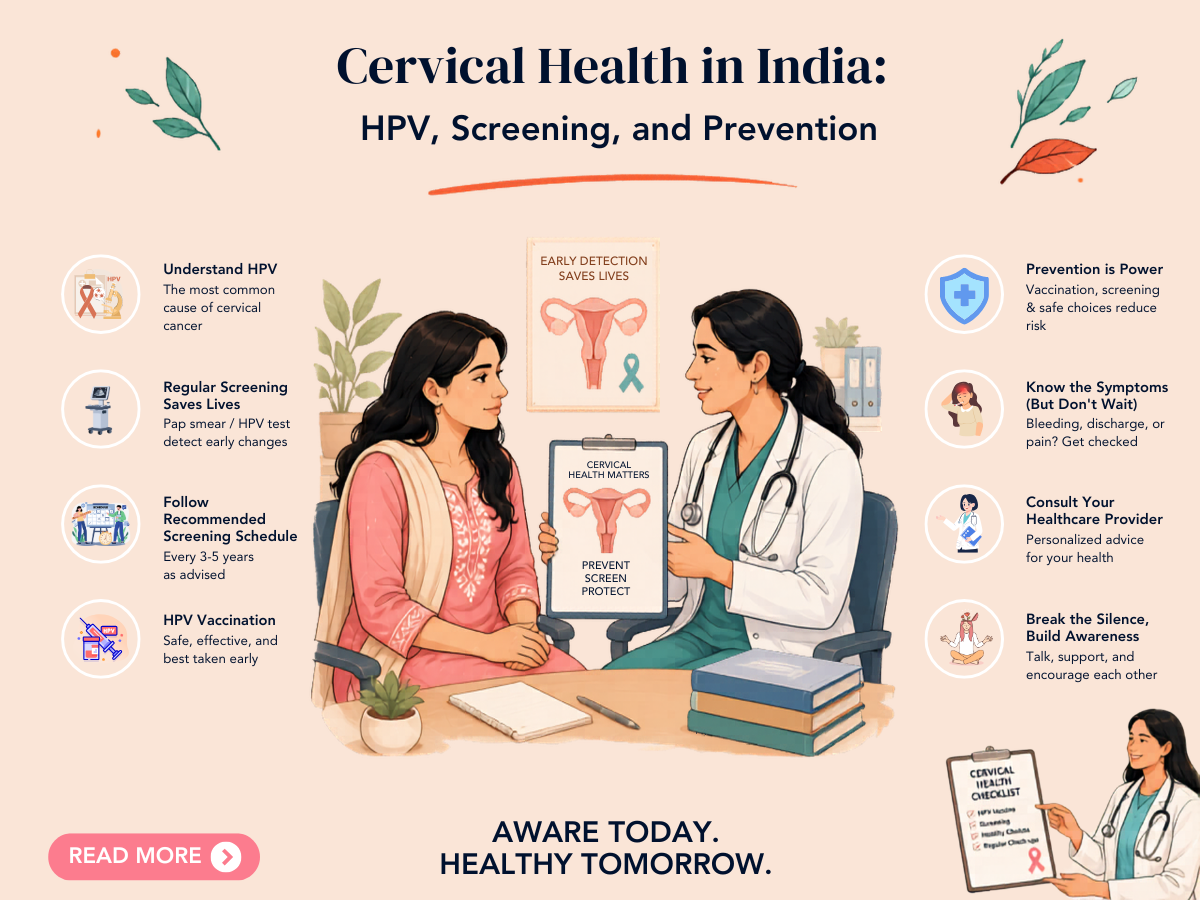
Cervical cancer is the second most common cancer among Indian women, after breast cancer — responsible for approximately 77,000 new diagnoses and 40,000 deaths annually. Almost every case of cervical cancer is caused by persistent infection with high-risk strains of human papillomavirus (HPV) — and almost every case is preventable through a combination of vaccination against HPV and regular cervical screening.
The tragedy of cervical cancer in India is not a lack of prevention tools — those tools exist and are effective. It is a failure of implementation: low screening rates, low vaccination uptake, and inadequate awareness among women and healthcare providers about what cervical health requires.
What Is HPV and How Does It Cause Cervical Cancer?
Human papillomavirus (HPV) is an extremely common sexually transmitted infection — the majority of sexually active people will be infected with HPV at some point in their lives, often without knowing it. There are over 100 HPV types. Most are cleared by the immune system within 1 to 2 years without causing any harm.
High-risk HPV types — particularly HPV 16 and HPV 18, which together cause approximately 70% of cervical cancers — can, in a small proportion of infected women, establish a persistent infection that causes dysplastic (pre-cancerous) changes in the cervical cells. This process from HPV infection to invasive cervical cancer typically takes 10 to 20 years, which is why cervical screening during this window is so effective at detecting and treating the pre-cancerous changes before they become cancer.
Other HPV-related cancers include oropharyngeal cancer, anal cancer, vulval cancer, vaginal cancer, and penile cancer. HPV 6 and 11 cause genital warts.
HPV Vaccination in India
Two HPV vaccines are currently available in India:
- Cervavac (quadrivalent, targeting HPV 6, 11, 16, 18): India's first domestically manufactured HPV vaccine, approved in 2023 and increasingly available through the national immunisation programme.
- Gardasil 9 (9-valent, targeting HPV 6, 11, 16, 18, 31, 33, 45, 52, 58): Protects against 7 high-risk HPV types responsible for approximately 90% of cervical cancers.
The vaccination schedule:
- 9 to 14 years (before sexual debut): 2 doses, 6 months apart — maximum effectiveness when administered before any HPV exposure.
- 15 to 26 years: 3 doses at 0, 1 to 2, and 6 months.
- 27 to 45 years: Vaccination can be discussed with healthcare provider — benefit is reduced in women who have already been exposed to HPV, but protection against unexposed types remains.
Vaccination does NOT eliminate the need for cervical screening — the vaccines protect against the most common high-risk types but not all of them. Screened and vaccinated women have the best protection.
Cervical Screening: What, When, and How Often
Cervical screening detects pre-cancerous changes in cervical cells before they develop into cancer. The main screening tools are:
Pap Smear (Cervical Cytology)
A spatula or brush is used to collect cells from the cervix, which are examined under the microscope for abnormalities. Pap smear has been the standard for decades. Its limitations: relatively high false-negative rate (misses some abnormalities) and requires skilled cytology interpretation.
Liquid-Based Cytology (LBC)
A newer, more sensitive method in which cells are collected in a liquid medium and processed to produce a cleaner cell preparation. Allows co-testing for HPV from the same sample. Increasingly preferred over conventional Pap smear in urban Indian centres.
HPV DNA Testing
Testing the cervical sample for the presence of high-risk HPV types — more sensitive than cytology for detecting underlying pre-cancerous changes. When negative, provides excellent reassurance (very low risk of developing cervical cancer over the next 3 to 5 years). When positive, cervical cytology is performed on the same sample (co-testing).
Recommended screening schedule for Indian women (adapted from FOGSI and WHO guidelines):
- First screening: From age 21, or within 3 years of first sexual activity — whichever comes first.
- Every 3 years: Cervical cytology (Pap or LBC) for women aged 21 to 29.
- Every 5 years: HPV co-testing (HPV test plus cytology) for women aged 30 to 65.
- Any woman with symptoms (post-coital bleeding, intermenstrual bleeding, post-menopausal bleeding, abnormal discharge) should be assessed immediately regardless of when her last screen was.
Abnormal Screening Results: What Happens Next
An abnormal cervical screen does not mean cancer. It means that there are cellular changes that require further investigation. The pathway:
- Low-grade changes (ASCUS, LSIL): May be followed with repeat testing in 6 to 12 months, or referred for colposcopy if high-risk HPV is present.
- High-grade changes (HSIL, CIN 2 or 3): Referred for colposcopy and usually treatment — typically loop excision (LLETZ) or cold coagulation to remove the abnormal cervical zone.
- Colposcopy: A clinic procedure in which the cervix is examined under magnification with the application of dilute acetic acid and Lugol's iodine — highlighting abnormal areas for targeted biopsy.
- LLETZ (Large Loop Excision of the Transformation Zone): A day-case procedure using a wire loop and diathermy to excise the abnormal cervical transformation zone. Highly effective for treating CIN 2 and 3 (pre-cancerous changes) — preventing progression to invasive cervical cancer.
Warning Symptoms That Should Not Be Ignored
Any of the following symptoms in a sexually active woman warrant urgent cervical assessment:
- Post-coital bleeding: Bleeding after intercourse — one of the most important warning signs of cervical pathology.
- Intermenstrual bleeding: Bleeding between periods.
- Post-menopausal bleeding: Any vaginal bleeding after 12 months of amenorrhoea requires urgent investigation.
- Abnormal vaginal discharge: Persistent, watery, blood-stained, or malodorous discharge.
- Pelvic pain not explained by menstruation.
Frequently Asked Questions
Q1. I am 35 and have never had a Pap smear. Should I have one now?
Yes — immediately. Cervical screening for sexually active women should begin at 21 (or 3 years after first sexual activity). At 35, you are 14 years overdue for your first screen. This is not said to alarm you — the pre-cancerous changes detected on cervical screening are slow-developing and very treatable — but the purpose of screening is to catch these changes early, and every year of delay is a year of missed detection opportunity.
Q2. I have had the HPV vaccine. Do I still need Pap smears?
Yes — absolutely. The HPV vaccine protects against the most common high-risk HPV types but not all of them. Regular cervical screening remains important even in vaccinated women. Vaccination + screening provides the strongest protection.
Q3. My Pap smear result was "CIN 1." What does this mean?
CIN 1 (Cervical Intraepithelial Neoplasia grade 1) represents low-grade cellular changes on the cervix. The majority of CIN 1 lesions — approximately 70% — resolve spontaneously without treatment, as the immune system clears the underlying HPV infection. Management is typically surveillance: repeat co-testing in 12 months, with referral for colposcopy if changes persist or progress. CIN 1 is not cancer and does not require immediate treatment in most cases.
DISCLAIMER: This article is for educational purposes only and does not constitute medical advice. Consult Dr. Sunita Tandulwadkar or a qualified specialist for personalised guidance. Solo Clinic IVF & ObGyn, Pune.