

DHEA and Ovarian Reserve: Can It Help Poor Responders?
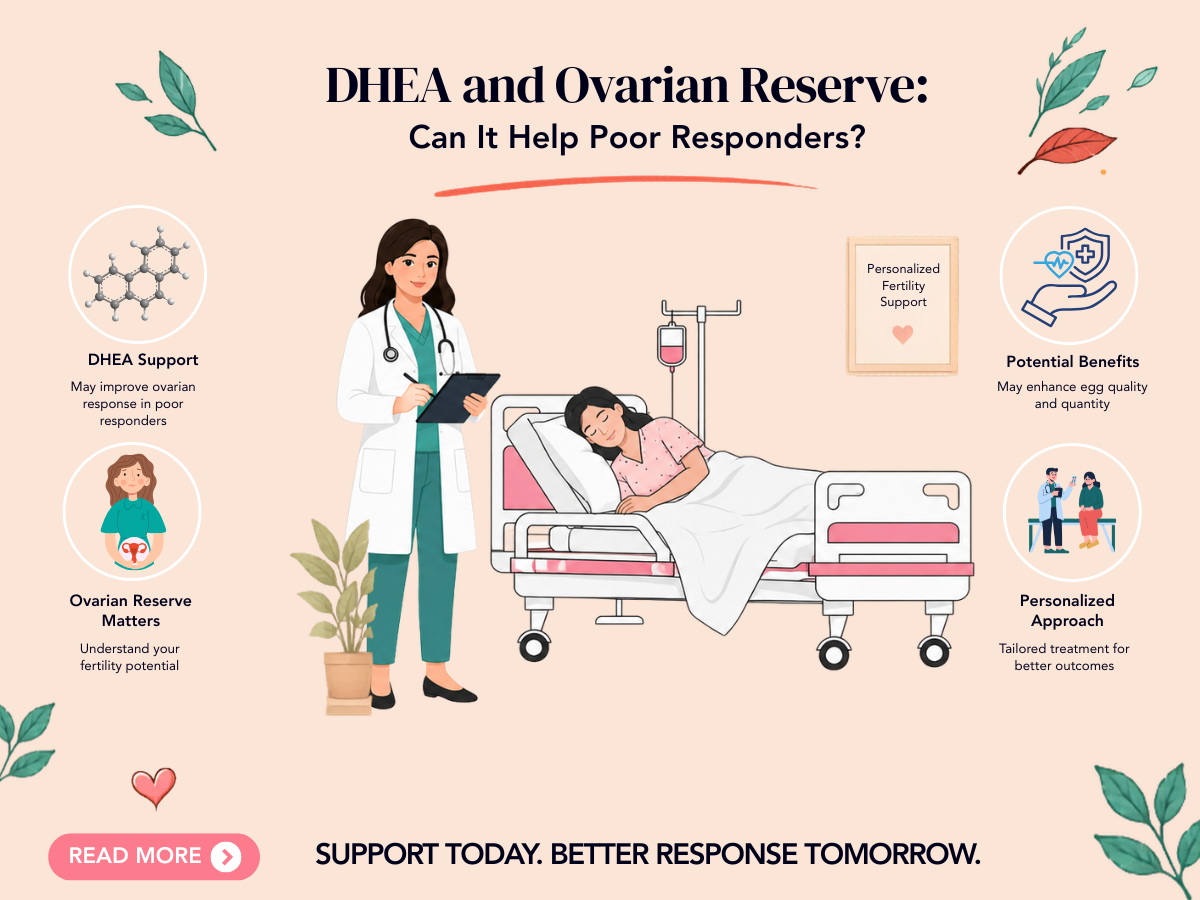
DHEA — dehydroepiandrosterone — is a naturally occurring steroid hormone produced by the adrenal glands, and the most abundant circulating steroid in the human body. It serves as the primary precursor for both oestrogen and testosterone biosynthesis, and its levels decline progressively with age from the mid-twenties onward. In the context of fertility, DHEA has attracted significant attention as a potential supplement for women with diminished ovarian reserve who are poor responders to IVF stimulation.
The Biological Rationale
Within the ovary, androgens (testosterone and androstenedione, both derived from DHEA) play an important role in early follicle development. Androgen receptors in granulosa cells of small antral follicles respond to androgen stimulation by upregulating FSH receptor expression — making developing follicles more sensitive to FSH. This has a direct clinical implication: in women with low androgen levels (which correlates with diminished reserve and declining DHEA), the follicles in the antral pool may be less FSH-responsive, requiring higher stimulation doses to recruit the same number of eggs.
DHEA supplementation, by restoring intra-ovarian androgen levels, may therefore:
- Improve follicle FSH sensitivity — potentially improving ovarian response even in poor responders
- Increase the number of antral follicles recruited per stimulation cycle
- Improve egg quality through androgen-mediated effects on granulosa cell function and mitochondrial activity
What the Evidence Shows
The evidence base for DHEA is more developed than for most fertility supplements, though still not definitively established by large RCTs:
- Multiple retrospective cohort studies from the New York group (Gleicher, Barad et al.) — the most prolific DHEA researchers in fertility medicine — report significantly improved IVF outcomes (more eggs, higher pregnancy rates, lower miscarriage rates) in women with DOR after DHEA supplementation for 3 to 6 months.
- A 2018 systematic review concluded modest but consistent improvements in ovarian response and clinical pregnancy rates in poor responders with DOR supplemented with DHEA before IVF.
- A 2019 RCT (Wiser et al.) found significant improvement in egg number and blastocyst rate in DOR women taking DHEA compared to placebo.
- Several studies also report reductions in chromosomal abnormality rates in embryos from DHEA-supplemented women — consistent with the mitochondrial support mechanism.
The overall evidence level is Tier 2 — multiple positive studies in the target population, a credible mechanism, acceptable safety profile — justifying selective use in DOR patients preparing for IVF.
Who Should Consider DHEA?
- Women with diminished ovarian reserve (AMH below 1.0 ng/ml, AFC below 7) who are classified as poor responders or anticipated poor responders
- Women who have previously had low egg numbers or very poor embryo quality despite standard or high-dose IVF stimulation
- Ideally, women with documented low androgen levels (testosterone, DHEAS) on blood testing — who are most likely to have the androgen-deficit phenotype that DHEA supplementation addresses
DHEA is not indicated for women with normal or elevated androgen levels (including most women with PCOS — who should avoid it, as it could worsen hyperandrogenism).
Dosage, Timing, and Safety
Standard protocol: 25 to 75 mg of micronised DHEA daily (most published studies use 75 mg, though 25 mg may be sufficient for some women). Duration: minimum 6 weeks before IVF cycle start, ideally 3 to 6 months.
Safety considerations:
- DHEA is androgenic — it can cause acne, oily skin, mild hirsutism (body hair increase), and — rarely — voice changes in susceptible women. These are dose-dependent and reversible on stopping.
- DHEA may lower HDL cholesterol modestly with long-term use — periodic lipid monitoring is appropriate.
- DHEA is contraindicated in women with a history of hormone-sensitive tumours (oestrogen or androgen-receptor positive cancers).
- Should not be used without medical supervision — blood DHEAS levels before starting and during supplementation help guide dosing.
- Stop DHEA once a positive pregnancy test is confirmed — there is no role for it during pregnancy.
Frequently Asked Questions
Q1. Can I buy DHEA without a prescription in India?
DHEA is available as a dietary supplement in India without a prescription. However, using it without baseline androgen level testing and medical supervision is not recommended — the dose matters, the indication matters, and the contraindications (PCOS, hormone-sensitive conditions) must be assessed before starting.
Q2. My AMH is 0.4. Will DHEA significantly improve my IVF outcome?
DHEA may improve your ovarian response modestly — producing more eggs per stimulation cycle and potentially better-quality embryos. Published data in this population suggests improvements in egg number and embryo quality, though the effect size varies. Combined with CoQ10 and vitamin D optimisation, DHEA is part of a comprehensive pre-IVF preparation protocol for poor responders. Realistic expectations — not a dramatic transformation, but a meaningful incremental improvement — are important.
Q3. I am 38 with normal AMH. Should I take DHEA?
No — DHEA supplementation for women with normal AMH and expected normal response to IVF stimulation has not been shown to benefit and could worsen androgenic symptoms without clinical justification. DHEA is a selective intervention for the DOR population, not a universal pre-IVF supplement.
DISCLAIMER: This article is for educational purposes only. Regenerative approaches in reproductive medicine are largely adjunctive and some remain investigational. Consult Dr. Sunita Tandulwadkar or a qualified specialist for personalised guidance. Solo Clinic IVF & ObGyn, Pune.