Egg Donor IVF in India: When It's the Right Choice
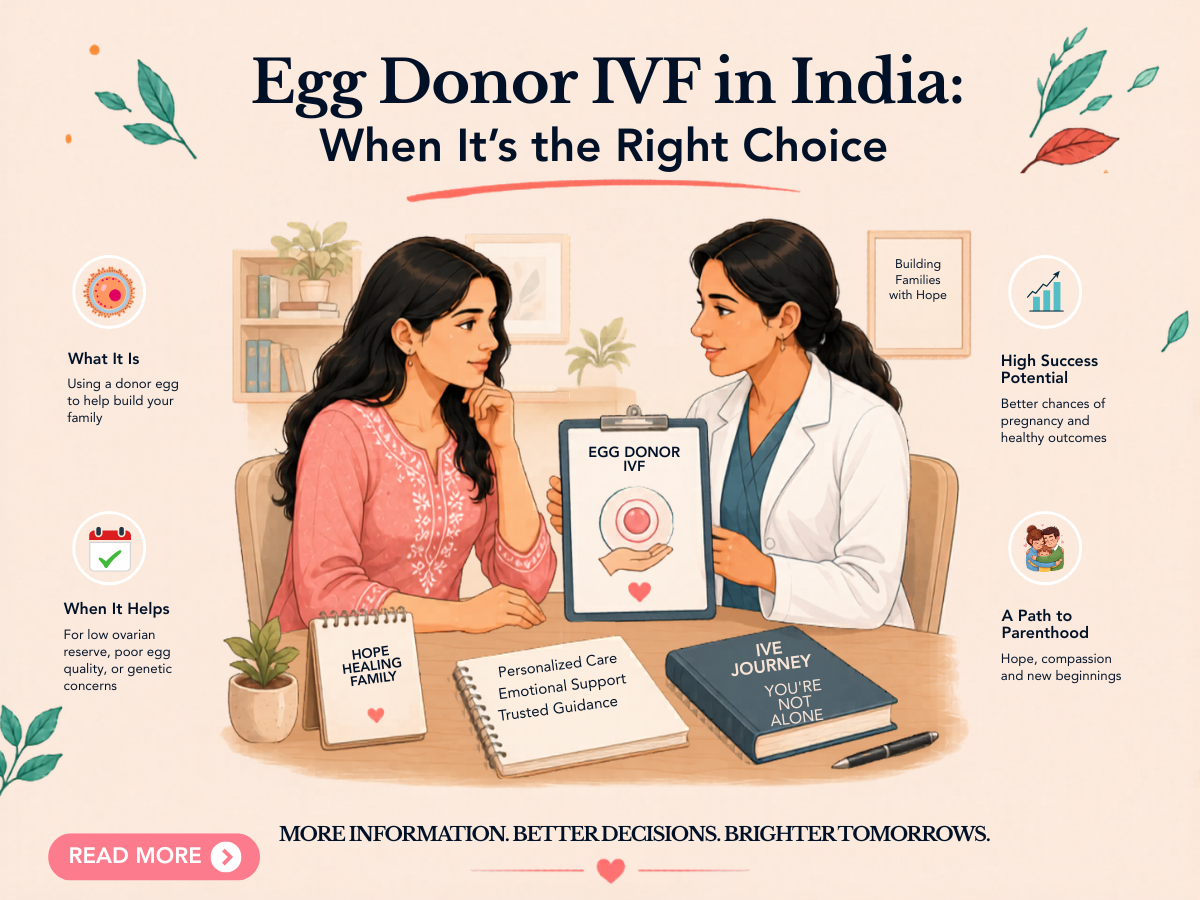
For some women and couples, the path to parenthood leads — eventually or immediately — to egg donation. The conversation about donor egg IVF can arrive in different ways: after multiple failed cycles with own eggs, after a diagnosis of premature ovarian insufficiency, at an age where own-egg IVF probabilities are very low, or occasionally as the first and most appropriate recommendation based on clinical assessment.
Donor egg IVF is emotionally complex — it involves questions of genetics, identity, and what it means to be a parent. But from a clinical perspective, it is one of the most powerful tools in reproductive medicine, offering success rates of 55 to 65% per transfer that are largely independent of the recipient's age.
When Is Donor Egg IVF Recommended?
The clinical indications for donor egg IVF include:
- Premature ovarian insufficiency (POI): Loss of normal ovarian function before age 40, characterised by absent or very infrequent periods, very low or undetectable AMH, and elevated FSH. In women with confirmed POI, own-egg IVF success rates are very low and donor eggs offer the most reliable path.
- Advanced reproductive age with severely diminished reserve: Women over 42 to 43, or younger women with very low AMH and poor IVF stimulation responses, whose own-egg IVF probability falls below a clinically meaningful threshold.
- Multiple failed cycles with own eggs despite good response: When several cycles have produced adequate numbers of embryos but none have resulted in a pregnancy or have all been aneuploid on PGT-A testing, egg quality is likely the central issue and donor egg IVF may be the most productive next step.
- Genetic conditions: Women carrying certain severe genetic disorders that cannot be reliably excluded by PGT may choose donor egg IVF to eliminate the transmission risk.
- Turner syndrome and other chromosomal conditions: Women with Turner syndrome often have absent or severely reduced ovarian function and typically require donor egg IVF.
How Egg Donation Works in India
Under the ART (Assisted Reproductive Technology) Regulation Act 2021, egg donation in India is regulated with specific legal requirements:
- Donors must be between 23 and 35 years old and have already had at least one child of their own.
- Each donor can donate to a maximum of 6 recipients in her lifetime.
- Donation is anonymous — neither the recipient nor the donor knows the identity of the other. The child has the right to access non-identifying health information when they reach adulthood.
- Donors are screened for infectious diseases, chromosomal abnormalities, genetic conditions, and psychological suitability.
- Donors are medically compensated for their time and inconvenience, but the commercial sale of eggs is prohibited.
The clinic coordinates the matching of donor and recipient — taking into account physical characteristics (height, skin tone, eye and hair colour, blood group) to allow a reasonable degree of phenotypic similarity.
The Donor Egg IVF Process
For the Donor
The donor undergoes the same ovarian stimulation, monitoring, and egg collection process as a standard IVF patient. Her cycle is carefully coordinated with the recipient's cycle so that the eggs are used at the optimal time, or frozen for use in a subsequent FET cycle.
For the Recipient
The recipient's uterus is prepared with oestrogen and progesterone (hormone replacement cycle) to create an optimal endometrial environment. This preparation is identical to the preparation for a frozen embryo transfer cycle. Embryos created from the donor's eggs and the partner's sperm (or donor sperm, where applicable) are transferred into the recipient's uterus.
Because the recipient is not undergoing ovarian stimulation, her physical experience of the cycle is relatively minimal — no injections other than progesterone, no egg collection, just the endometrial preparation and the transfer itself.
Donor Egg IVF Success Rates
The most significant advantage of donor egg IVF is that success rates are primarily determined by the donor's age — not the recipient's. Because donors are typically 23 to 30 years old, the egg quality is excellent. Per-transfer live birth rates are approximately:
- Fresh donor egg cycle: 55 to 65% per transfer
- Frozen donor egg cycle (previously vitrified donor eggs): 50 to 60% per transfer
- These rates are broadly consistent across recipient age groups from 25 to 50+ — the uterus remains receptive to a high-quality embryo well beyond the age at which the ovaries cease to produce viable eggs.
The Emotional Dimension
For many recipients, the decision to use donor eggs requires processing significant emotional complexity. Questions about genetic connection, what to tell the child, and the experience of carrying a pregnancy without a genetic contribution are all real and important.
At Solo Clinic, counselling support is integral to the donor egg process, not optional. Research on families formed through egg donation consistently shows that the parenting relationship — built through pregnancy, birth, and years of care — is experienced as fully authentic by the vast majority of recipient parents. Many couples also find it meaningful that the pregnancy itself — the physical experience of carrying and nourishing the baby — is entirely their own.
How much to tell a child, and when, is a personal decision. Trends in contemporary practice and psychological research increasingly support age-appropriate disclosure — telling children about their origins from an early age in a matter-of-fact, normalised way. This is worth discussing with a counsellor who specialises in donor conception families.
Frequently Asked Questions
Q1. Can I choose my egg donor?
Under Indian ART regulations, donation is anonymous — recipients cannot select a specific named donor or view identifying personal information. The clinic matches donors and recipients based on physical characteristics and blood group. Detailed medical and genetic screening information about the donor is available. This process protects the privacy of all parties.
Q2. Is my baby legally mine if I use donor eggs?
Yes, unequivocally. Under Indian law, the woman who carries and delivers the baby is the legal mother. No further legal steps are required. Donor eggs do not confer any parental rights on the donor.
Q3. How many embryos are transferred in a donor egg cycle?
In most cases, a single embryo transfer is recommended — particularly when the donor is young and embryo quality is high. Multiple embryo transfer significantly increases the risk of twin pregnancy, which carries substantially elevated risks of preterm birth, low birth weight, and maternal complications. Your clinical team will advise based on your specific situation.
Q4. What if I want to try own-egg IVF before considering donor eggs?
This is entirely respected. At Solo Clinic, the decision to move to donor eggs is never made unilaterally or without full patient discussion. If you want to try own-egg IVF first, your team will support that decision — providing you with honest, updated assessment of probability at each stage. The conversation about donor eggs is offered as information, never as pressure.
DISCLAIMER: This article is for educational purposes only and does not constitute medical advice. Every patient's case is unique. Please consult Dr. Sunita Tandulwadkar or a qualified fertility specialist for personalised guidance. Solo Clinic IVF & ObGyn, Pune.