Fertility Preservation for Cancer Patients: Beyond Egg Freezing
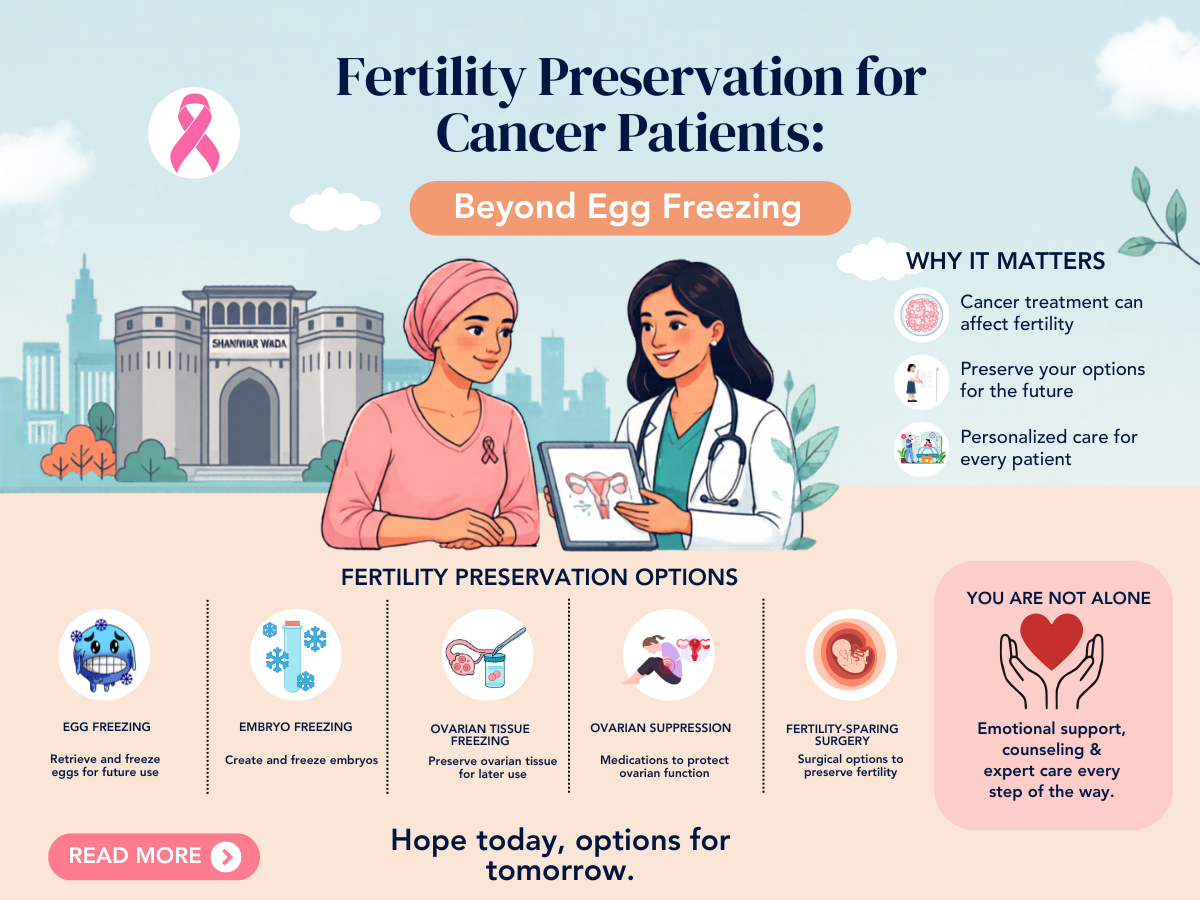
For women facing cancer treatment, egg freezing is the most widely discussed fertility preservation option — but it is not the only one. Depending on the type of cancer, the urgency of treatment, the patient's age, and whether she has a partner, other approaches — embryo freezing, ovarian tissue cryopreservation, ovarian transposition, and GnRH agonist co-treatment — may be more appropriate, or may be used alongside egg freezing to provide the broadest possible protection.
This guide covers the full range of fertility preservation options for women with cancer, so that every patient and her oncology team can make the most informed decision possible.
Option 1: Egg Freezing (Oocyte Cryopreservation)
As discussed in the dedicated oncofertility article, egg freezing is the primary option for single women — or those who do not want to commit to a specific sperm source — who have 2 to 4 weeks before treatment begins. A stimulation cycle (with letrozole co-stimulation for ER+ breast cancer) produces 8 to 15 mature eggs, which are vitrified and stored.
Limitations: Requires a minimum of 10 to 14 days of stimulation. Not suitable for prepubertal girls. For very urgent treatments (acute leukaemia, aggressive lymphoma), this window may not be available.
Option 2: Embryo Freezing
For women with a partner who are ready to create embryos together, embryo freezing — fertilising collected eggs and culturing to blastocyst before vitrification — offers marginally higher per-unit survival rates than egg freezing and has the longest track record of clinical success.
The same process as egg freezing for the stimulation and collection phases; the difference is in the laboratory (fertilisation and culture before vitrification rather than freezing unfertilised eggs).
For women with ER+ breast cancer: the letrozole co-stimulation protocol is used equally for embryo freezing, keeping oestradiol at near-physiological levels throughout.
Option 3: Ovarian Tissue Cryopreservation (OTC)
OTC is performed laparoscopically — under general anaesthesia, the outer layer (cortex) of one ovary (or part of both) is removed, sliced into thin strips, and vitrified or slow-frozen. When the woman wishes to conceive after cancer treatment, the ovarian cortex strips are transplanted back to the remaining ovary or another suitable site — typically the peritoneum. The transplanted tissue begins producing hormones and maturing follicles within 3 to 6 months.
When is OTC the right choice?
- Women who cannot delay cancer treatment even 10 to 14 days for stimulation — OTC can be performed as a single laparoscopic procedure immediately, even on the day before chemotherapy begins.
- Prepubertal girls: Cannot undergo ovarian stimulation (which requires FSH sensitivity that develops after puberty) or produce mature eggs for collection. OTC is the only established option for this group.
- Women who want to also preserve endocrine (hormone) function alongside fertility — reimplanted ovarian tissue resumes hormonal production, preventing or delaying premature surgical menopause.
The critical caveat — cancer cell contamination: OTC carries a theoretical risk of reimplanting malignant cells along with the ovarian tissue, if the original cancer involved the ovary or had metastasised to it. This risk is highest in leukaemia (where ovarian involvement is common). For solid tumours with low risk of ovarian involvement (breast cancer, lymphoma), the risk is very low and OTC is increasingly standard. For leukaemia and some ovarian cancers, OTC is contraindicated or requires specific safety testing.
OTC has produced over 200 live births worldwide and is now considered an established (no longer experimental) fertility preservation option by major guidelines.
Option 4: Ovarian Transposition (Oophoropexy)
For women who will receive pelvic radiation (but not chemotherapy), ovarian transposition is a surgical option that physically moves the ovaries outside the radiation field before treatment begins. Performed laparoscopically, the ovaries are relocated to the upper abdomen (or another shielded location), protected by lead shielding during radiation, and — once treatment is complete — remain in place or are repositioned.
Transposition can preserve ovarian function (hormonal and fertility) in approximately 50 to 80% of cases, depending on radiation scatter. It does not protect against chemotherapy-related damage and does not preserve eggs outside the body — the eggs remain inside the relocated ovary. If the woman subsequently needs IVF, eggs must be retrieved from the transposed ovarian location (which may require ultrasound-guided retrieval in a non-standard position).
Option 5: GnRH Agonist Co-Treatment During Chemotherapy
GnRH agonists (such as leuprolide or goserelin) suppress ovarian activity during chemotherapy by suppressing FSH and LH — putting the ovaries into a temporary prepubertal-like hormonal state. The theory is that this reduces follicle sensitivity to gonadotoxic agents.
The evidence is mixed. The POEMS trial showed that monthly goserelin injections during chemotherapy in premenopausal breast cancer patients significantly improved ovarian function preservation and pregnancy rates compared to chemotherapy alone. Other trials have shown less consistent benefit.
Current consensus: GnRH agonist co-treatment is not a substitute for established fertility preservation (egg or embryo freezing) but may offer additional protection when used alongside it, particularly for women who could not complete a full egg freezing cycle before chemotherapy.
Frequently Asked Questions
Q1. I was not offered fertility preservation before my cancer treatment. Is it too late after treatment?
Not necessarily — it depends on what residual ovarian function remains. After gonadotoxic treatment, AMH and AFC testing will reveal whether any follicle activity persists. If AMH is detectable and AFC shows antral follicles, stimulation and egg collection may still be possible. For women with very low or undetectable AMH after treatment, donor egg IVF is the most reliable remaining option. A specialist fertility assessment after treatment — not immediately, but once medically stable — is always worthwhile.
Q2. Can I have ovarian tissue reimplanted if I had leukaemia?
This requires case-by-case assessment by both an oncologist and a reproductive specialist experienced in OTC. Modern safety testing — including PCR testing of ovarian tissue for malignant cells before reimplantation — has improved the safety profile. Some centres have reimplanted tissue after leukaemia in selected patients with appropriate safeguards. This is a decision requiring very specialised expertise and should be discussed with both the oncology and fertility teams.
Q3. How quickly can Solo Clinic mobilise an oncofertility cycle?
For women with an urgent cancer treatment timeline, we can begin a random-start stimulation protocol (starting on any day of the cycle, not waiting for the next period) within 24 to 48 hours of a consultation. This compresses the total time from decision to egg collection to as little as 10 to 12 days. We work directly with oncology teams to coordinate timing around biopsy results, surgical scheduling, and chemotherapy start dates.
DISCLAIMER: This article is for educational purposes only and does not constitute medical advice. Consult Dr. Sunita Tandulwadkar or a qualified specialist for personalised guidance. Solo Clinic IVF & ObGyn, Pune.