
Preterm Labour: How to Reduce Your Risk and What to Do if It Happens
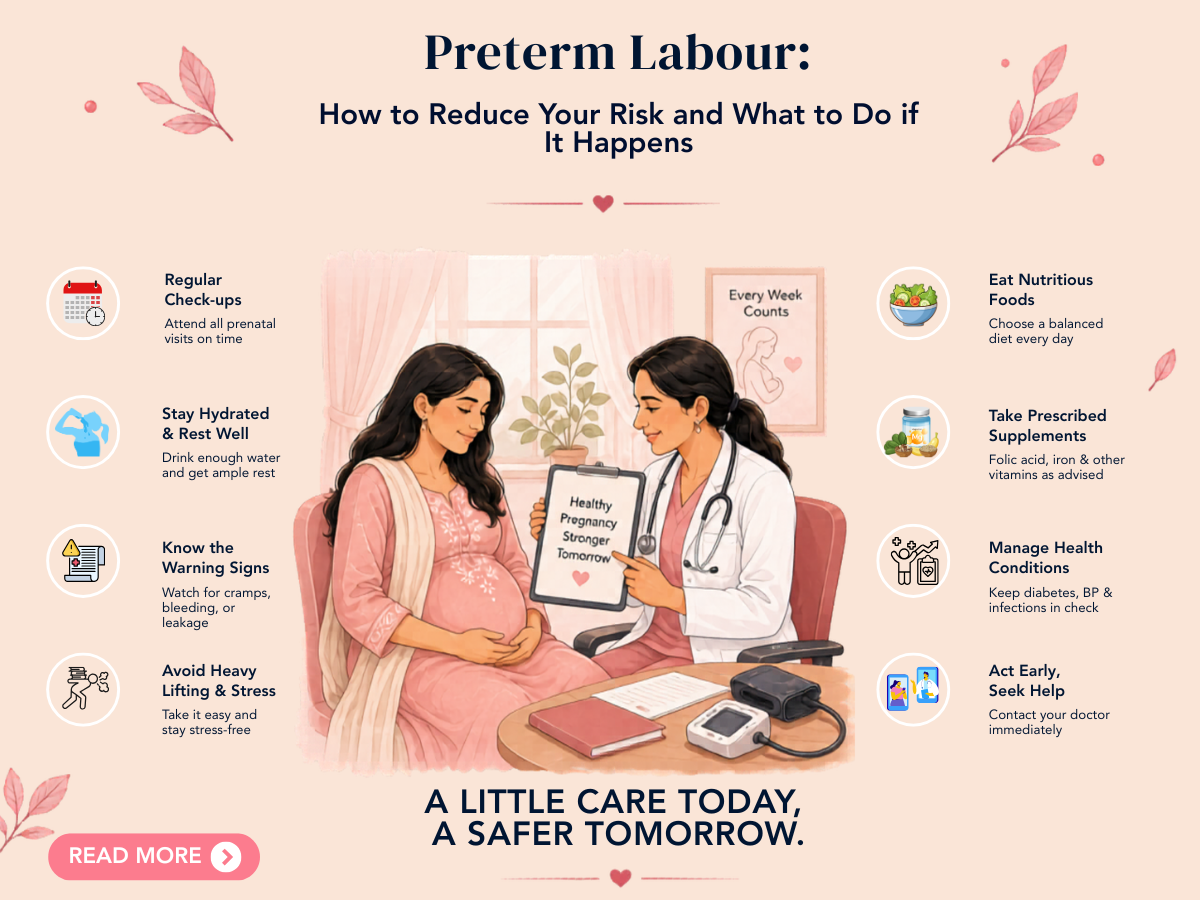
Preterm birth — delivery before 37 weeks of gestation — is the leading cause of neonatal death and disability worldwide. In India, approximately 10 to 13% of births are preterm, placing the country among the highest-burden nations globally. Despite decades of research, preterm birth remains one of the most difficult obstetric problems to prevent — but risk stratification, surveillance, and targeted interventions can meaningfully reduce the rate in women at highest risk.
Defining Preterm Birth
- Moderate to late preterm: 32 to 36+6 weeks — the majority of preterm births. Neonatal outcomes are generally good with appropriate care; some may require NICU support.
- Very preterm: 28 to 31+6 weeks — significant NICU support required; morbidity risk elevated.
- Extremely preterm: Below 28 weeks — significant mortality and morbidity risk; survival rates improve with each additional week.
Causes and Types
Preterm birth has two broad categories with different causes and management implications:
- Spontaneous preterm birth: Accounts for approximately 60 to 70% of preterm births. Results from spontaneous preterm labour (contractions with cervical dilation) or preterm pre-labour rupture of membranes (PPROM — amniotic membranes rupture before labour begins). Causes include infection, cervical incompetence, uterine overdistension (twins, polyhydramnios), and maternal systemic conditions.
- Provider-initiated preterm birth: Approximately 30 to 40% — delivery is initiated by the medical team because of maternal or foetal compromise (severe pre-eclampsia, foetal growth restriction with abnormal Doppler, placental abruption). Not preventable in the same sense as spontaneous preterm birth — it is a life-saving intervention.
Risk Factors for Spontaneous Preterm Birth
- Previous spontaneous preterm birth: The single most important risk factor. Women with a previous preterm birth below 34 weeks have approximately a 15 to 30% risk of recurrence.
- Cervical incompetence or short cervix: A cervical length below 25 mm at 20 to 24 weeks significantly elevates preterm risk. May be constitutional or result from previous cervical surgery (LLETZ/LEEP, cone biopsy, cervical cerclage).
- Multiple pregnancy: Twin and higher-order pregnancies significantly distend the uterus, triggering preterm labour.
- Intrauterine infection: Bacterial vaginosis, ascending genital tract infection, and subclinical intra-amniotic infection are associated with preterm rupture of membranes and preterm labour.
- Uterine anomalies: Septate or bicornuate uterus, fibroids distorting the cavity.
- Polyhydramnios: Uterine overdistension from excess amniotic fluid.
- Extremes of maternal age, low socioeconomic status, poor nutrition, high-stress environments, smoking.
Prevention Strategies
Cervical Length Surveillance
Universal or risk-based cervical length measurement by transvaginal ultrasound at 20 to 24 weeks identifies women with a short cervix (below 25 mm). In twin pregnancies, cervical length below 38 mm at 20 weeks is also a significant predictor.
Vaginal Progesterone
For singleton pregnancies with a short cervix (below 25 mm at 20 to 24 weeks), daily vaginal progesterone (200 mg micronised progesterone pessary at bedtime) reduces preterm birth risk by approximately 35 to 45%. This is one of the most evidence-based and cost-effective interventions in obstetrics. It is safe, well-tolerated, and should be offered to all eligible women identified on cervical length screening.
For twin pregnancies, the evidence for vaginal progesterone is more limited — it is used in some guidelines for twin pregnancies with a short cervix, but has not shown benefit in unselected twin pregnancies.
Cervical Cerclage
Cervical cerclage — a stitch placed around the cervix to mechanically support it — is used in selected women with:
- History-indicated cerclage: Placed electively at 12 to 14 weeks in women with a history of recurrent second-trimester loss or painless cervical dilation (cervical incompetence).
- Ultrasound-indicated cerclage: Placed when a short cervix is detected on surveillance, particularly in women with a previous preterm birth.
- Rescue cerclage: Emergency placement when the cervix is found to be dilating without contractions. Associated with significant risk of membrane rupture but can sometimes extend pregnancy meaningfully.
Treating Infection
Screening for and treating bacterial vaginosis in the first or second trimester in women with a previous preterm birth has been shown to reduce preterm birth rates in some studies. Treatment with clindamycin or metronidazole is appropriate for confirmed BV in at-risk pregnancies.
If Preterm Labour Begins: Acute Management
When preterm contractions with cervical change begin before 34 weeks, the following interventions are used:
- Tocolysis: Medications to temporarily suppress contractions — nifedipine (calcium channel blocker) or atosiban (oxytocin receptor antagonist). Tocolysis buys 24 to 48 hours — not weeks — of time for the following two interventions.
- Corticosteroids (betamethasone or dexamethasone): A course of two injections 24 hours apart dramatically accelerates foetal lung maturity and significantly reduces rates of respiratory distress syndrome (RDS), intraventricular haemorrhage (IVH), and necrotising enterocolitis (NEC) in preterm babies. This is the single most important intervention in threatened preterm birth.
- Magnesium sulphate: Given when delivery before 32 weeks is anticipated — significantly reduces the risk of cerebral palsy in the preterm infant.
- Transfer to appropriate centre: Delivery should take place at a hospital with a NICU capable of managing the expected gestational age of delivery.
Frequently Asked Questions
Q1. My cervix is 22 mm at 22 weeks. Is this serious?
Yes — a cervical length of 22 mm at 22 weeks is below the 25 mm threshold that defines high risk for preterm birth in singleton pregnancies. This finding warrants starting vaginal progesterone (200 mg nightly), more frequent cervical length surveillance, and discussion of whether cerclage is appropriate depending on your specific history. Rest and pelvic rest (avoiding intercourse) are commonly advised, though evidence for rest alone is limited.
Q2. I had a preterm birth at 32 weeks in my last pregnancy. What can be done this time?
Given your history, you should: have cervical length surveillance from 14 to 16 weeks (every 2 weeks until 24 weeks); be considered for elective cervical cerclage at 12 to 14 weeks if there is any history of cervical incompetence; start vaginal progesterone at 16 weeks prophylactically in some guidelines; have more frequent antenatal appointments with growth scans and Doppler from 28 weeks. A preconception or early pregnancy consultation with a high-risk obstetrician should happen ideally before the next pregnancy begins.
DISCLAIMER: This article is for educational purposes only and does not constitute medical advice. Every pregnancy is unique. Please consult Dr. Sunita Tandulwadkar or your qualified obstetrician for personalised guidance. Solo Clinic IVF & ObGyn, Pune.