Secondary Infertility: When Getting Pregnant Again Is Harder Than the First Time
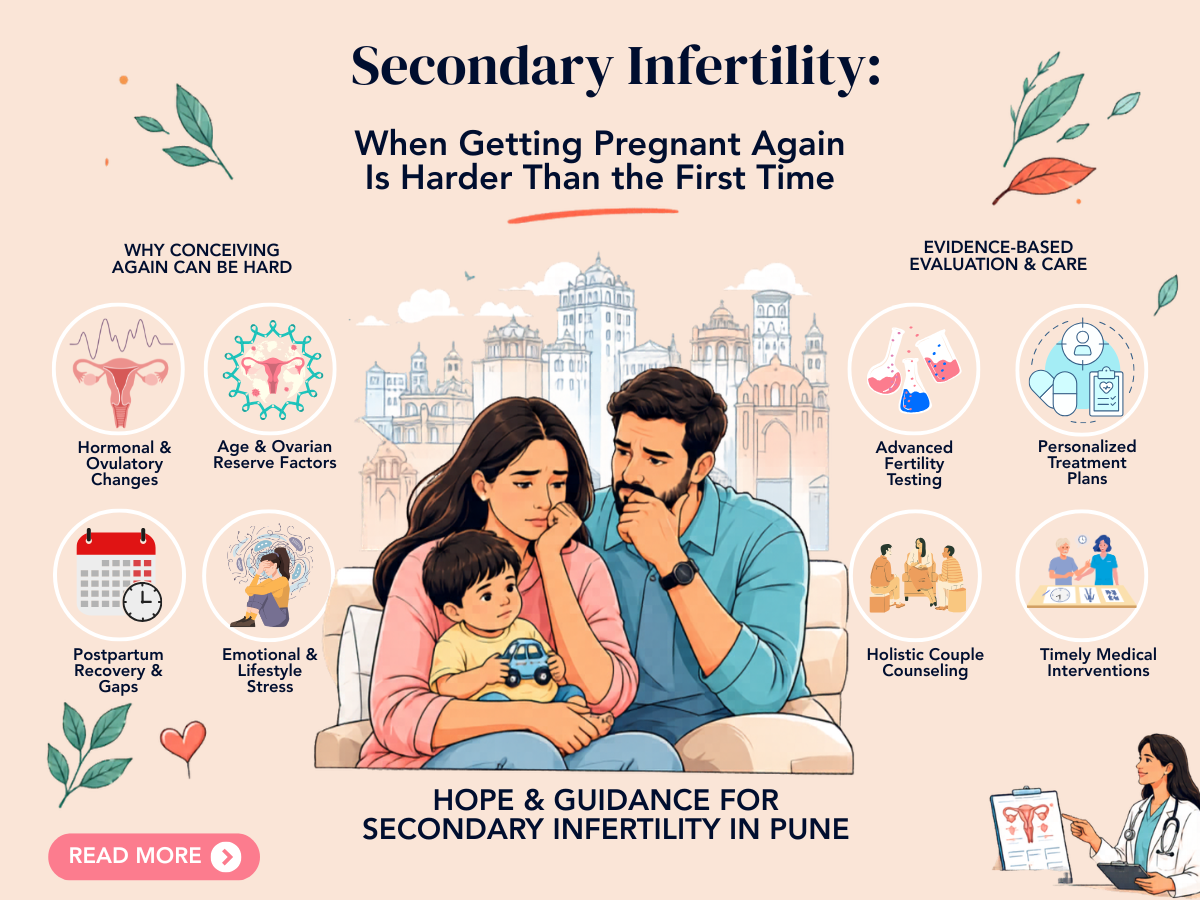
Secondary infertility — the inability to conceive or carry a pregnancy to term after having previously conceived, with or without treatment — is one of the least discussed and least supported experiences in the fertility community. Couples who are struggling to have a second child often feel overlooked, or even judged: "You already have one — be grateful." The grief of secondary infertility is real. The medical problem is real. And it deserves the same attention as primary infertility.
Secondary infertility is more common than many couples realise. In India, it is estimated to account for approximately 30% of infertility presentations. Understanding why it happens, how it differs from primary infertility, and what the investigation and treatment pathway looks like is the purpose of this article.
Why Does Secondary Infertility Happen?
Secondary infertility has the same range of causes as primary infertility — ovulatory disorders, tubal damage, uterine pathology, male factor, and diminished ovarian reserve — but with some important differences in relative frequency and cause:
Age-Related Decline
The most common explanation for secondary infertility is simply time. A couple who conceived easily at 29 may find, attempting a second pregnancy at 34 to 35, that the same ease does not apply. Ovarian reserve has declined, egg quality has reduced, and the biological efficiency of natural conception has fallen. For women over 35 attempting a second pregnancy, age-related factors are by far the most common underlying issue — even if everything else is unchanged.
New Male Factor
Semen quality can change significantly over time. A man who had normal parameters 3 to 4 years ago may now have reduced count, motility, or elevated DNA fragmentation — from lifestyle factors (weight gain, smoking, heat exposure), new medications, or a new varicocele. The male partner should always have a current semen analysis in secondary infertility — not rely on a previous normal result.
Uterine Changes from Previous Delivery or Procedures
The uterine environment can change after a previous pregnancy, delivery, or procedure:
- Intrauterine adhesions (Asherman's syndrome): Can develop after postpartum haemorrhage, a difficult delivery requiring uterine surgery, retained products of conception requiring curettage, or a D&C. Adhesions reduce the functional endometrial surface and impair implantation.
- Uterine fibroids: Can develop or grow significantly between pregnancies, particularly as a woman enters her mid-to-late thirties.
- Endometrial polyps: Can develop silently and impair implantation without causing significant symptoms.
- Uterine scar (isthmocele): A niche or defect in the uterine scar from a previous caesarean section — associated with abnormal bleeding, pelvic pain, and impaired implantation.
New Tubal Damage
A pelvic infection, a difficult second delivery, or pelvic surgery in the interval between pregnancies can cause tubal damage that was not present at the time of the first conception. A history of any pelvic procedure or infection since the last pregnancy should always be explored in the secondary infertility history.
PCOS or Hypothyroidism — Newly Developed or Worsened
Hormonal conditions can emerge or worsen in the interval between pregnancies. PCOS may manifest more clearly as insulin resistance accumulates with age and weight change. Hashimoto's thyroiditis and hypothyroidism are progressive — a woman who was euthyroid at the first pregnancy may have developed subclinical or clinical hypothyroidism by the time she is trying for a second. A full hormonal panel is essential.
The Investigation of Secondary Infertility
Secondary infertility deserves a complete, systematic investigation — identical in scope to the evaluation of primary infertility:
- Current semen analysis for the male partner — even if previously normal
- Hormonal panel for the female partner: AMH, FSH, LH, oestradiol, prolactin, TSH, fasting glucose/insulin
- Transvaginal ultrasound: uterine assessment, antral follicle count, and detection of fibroids, polyps, or adhesions
- Uterine cavity assessment: hysteroscopy or saline infusion sonography to detect adhesions, polyps, or caesarean scar defect
- Tubal assessment: HSG or laparoscopy if history suggests risk
Importantly, previous fertility — whether natural or with treatment — does not exclude any of these findings. Each should be assessed fresh.
How Long to Wait Before Investigating Secondary Infertility
The same age-appropriate timelines apply to secondary infertility as to primary infertility:
- Under 35: 12 months of unprotected regular intercourse before investigation
- 35 to 37: 6 months
- 38 and above: Investigate promptly — do not wait
For couples where the woman is 35 or above, the period between first and second pregnancy has often brought them into an age range where time is more precious. If you are 37 and attempting a second pregnancy, waiting a year before investigating means attempting through the year when your reserve will decline most rapidly. Investigate sooner.
Treatment
Treatment for secondary infertility is identical to treatment for the primary infertility cause identified — ovulation induction for anovulation, hysteroscopy for uterine pathology, IVF for tubal factor or persistent unexplained infertility, ICSI for new male factor. There is no second-tier approach for secondary infertility. It is treated with the same evidence-based tools as primary infertility.
The Emotional Dimension
Secondary infertility is frequently associated with guilt — "I should be grateful for the child I have" — and a sense that the grief is not legitimate because a child already exists. This is incorrect. The desire to complete a family is a legitimate and important human experience. Grief at secondary infertility is real and valid.
Additionally, couples in secondary infertility often receive less acknowledgement from their social circle and even their healthcare providers, who may minimise the situation. If you are finding it difficult to conceive a second child, you deserve the same comprehensive assessment and support as any couple facing fertility challenges for the first time.
Frequently Asked Questions
Q1. We conceived naturally the first time. Do we definitely need medical help this time?
Not necessarily — but after the age-appropriate waiting period without success, a complete investigation is warranted. The previous conception does not exclude any current fertility problem. Many couples do eventually conceive naturally; others find that an identifiable and treatable factor has emerged since the first pregnancy.
Q2. My caesarean scar — could this be affecting my fertility?
A caesarean scar defect (isthmocele) can cause abnormal intrauterine fluid collection, poor blood flow in the scar area, and impaired endometrial function — all of which can impair implantation. It is diagnosed on transvaginal ultrasound or hysteroscopy. Hysteroscopic repair of a significant isthmocele can improve outcomes in selected cases. This is worth specifically investigating if you have had a previous caesarean and are having difficulty conceiving a second child.
Q3. How does the treatment of secondary infertility differ from primary?
It does not differ in terms of the treatments available or their effectiveness — the same tools apply. The practical difference is in what is found. Secondary infertility is more likely to involve uterine changes from previous delivery or procedures, new male factor, and age-related decline. The investigation is identical; the most commonly identified causes differ somewhat from primary infertility.
DISCLAIMER: This article is for educational purposes only and does not constitute medical advice. Every patient's situation is unique. Please consult Dr. Sunita Tandulwadkar or a qualified fertility specialist for personalised guidance. Solo Clinic IVF & ObGyn, Pune.